Research Interests

My research interests include Data Science, Natural Language Processing, and Research Data Management with a strong focus on Open Science and Reproducibility. My work focusses on methods for information and data management by using techniques of natural language processing and data mining in multiple disciplines such as life-, natural-, and information sciences, but also Digital Humanities and Theology.

Selected Current and Past Projects

Electrically Active Implants

SFB 1270 ELAINE - Electrically Active Implants - Subproject Information Infrastructure (3rd funding period)

The infrastructure support project addresses the professional management of research data raised, processed and archived in the research projects. Its overarching goal is to ensure the quality, productivity and competitiveness of the CRC in terms of data management. A comprehensive data management plan will be negotiated and implemented. A training and qualification programme for the foundations of reproducible research, open science and data management will also be provided. The promotion of open science is a central objective.

  • Duration: 2026–2029
  • Funder: DFG

More information

GenderVarianten

GenderVarianten

The project combines New Testament textual criticism, analyses of the reception of gender constructions, and information science research as well as systematic-ethical investigations. The central concern of the project is to analyze how digitally assisted research can help interdisciplinary gender studies to new possibilities in analyzing the transmission of texts and the related uncovering of gender understandings. This will demonstrate in an interdisciplinary manner:

  1. digitization in New Testament scholarship, and in particular in textual criticism, can help to gain new insights, especially with regard to gender studies,
  2. the help of these instruments, theological gender research is to be advanced with regard to insights into textual evidence of variations as well as the creation of editions in view of the construction of gender, and the question of remembering, handing down and forgetting is to be addressed from a hermeneuticethical point of view,
  3. information-scientific methods for the automatic identification of gender-specific changes in edition and revision histories are to be developed.
These multidimensional aspects, which encompass the plurality of gender conceptions and textual variants, are subsumed under the term GenderVariants. The notation expresses that LGBTQIA+ intersectionality is examined multidimensionally: gender ascriptions are uncovered in texts and redactions are traced. Historical contextualization as well as principles of change or patterns are elaborated. These findings are linked to contemporary histories of revision. It will be taken into account that gender conceptions in the sense of an intersectional approach are also in relation to discriminations based on social status, origin, appearance, etc. and, to this end, even the conceptions of "masculine" and "feminine" are not to be understood essentialistically, but can be designed fluidly. The extent to which methods of automatic textual analysis are suitable for identifying gender-specific differences between different variants and editions will be investigated. In addition to the New Testament texts, the automatic identification methods are applied to Wikipedia revision histories. This will enable both the generalizability of the methods and their direct application in the analysis of current gender issues. The research project contributes to the research the desiderata in theology, gender studies and computer science.
  • Duration: 2023–2027
  • Funder: DFG

ScannedTables

Tool support for the automatic extraction of table data from historical journals

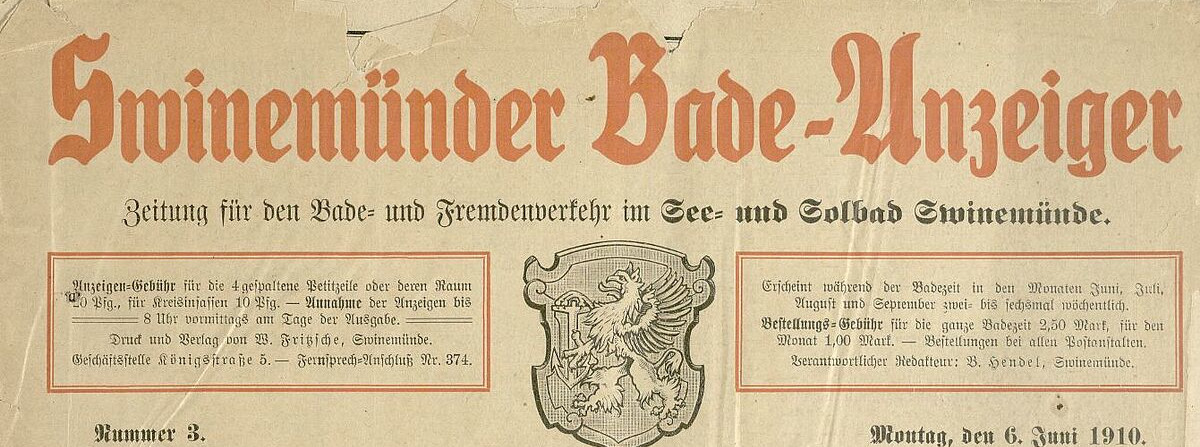
Qualitative and quantitative data analyses require a structured database in all specialist disciplines. Textual data, such as that found in newspapers, is often provided with additional tabular data in order to communicate information in a structured manner. At first glance, such tables appear structured, but in most cases they are to be regarded as semi-structured or unstructured, as it is often not possible to access individual elements of the data set in a targeted manner. The aim of this project is to investigate the extent to which existing solutions for table extraction can be applied to historical journals. The aim is to develop a toolchain that allows tables with personal data to be extracted and processed in a reproducible manner using the historical journal Swinemünder Badeanzeiger in order to be used as a database for subsequent analysis. The project is funded as cooperation project within the NFDI Consortium Text+.

Datenkompass MV

Datenkompass M-V: Competence Network for Research Data in Mecklenburg-Vorpommern

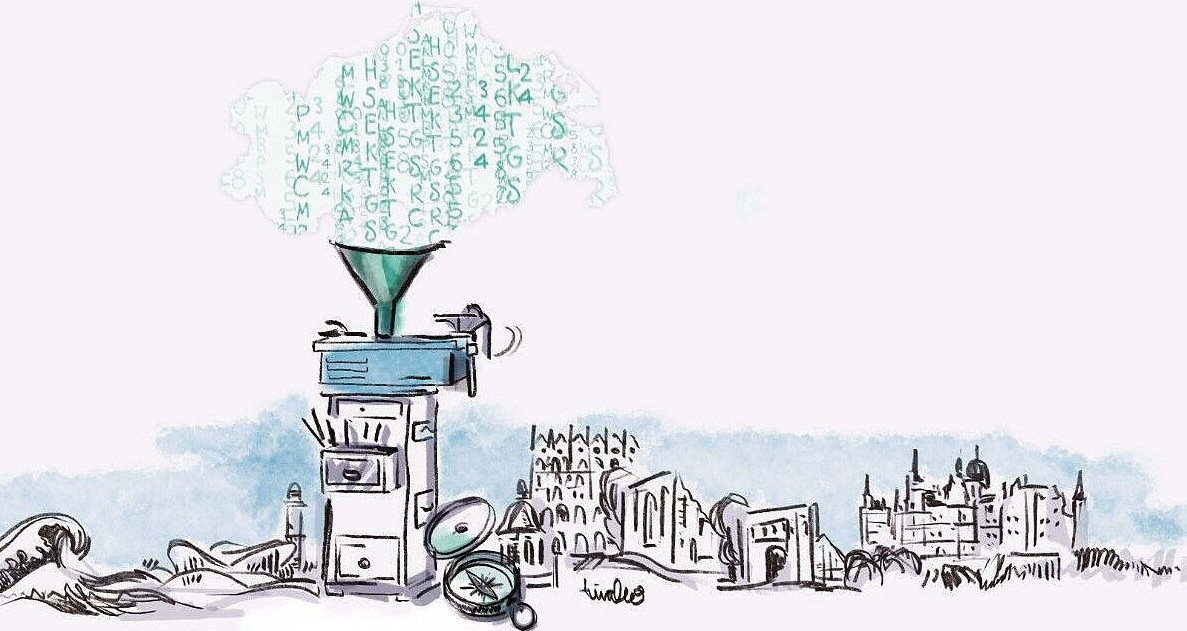
The Datenkompass M-V (DKMV) supports the interdisciplinary acquisition of application-oriented competencies in the fields of research data management and data science. The Datenkompass Mecklenburg-Vorpommern (DKMV) project aims to establish a data competency network in M-V. The goal is to consolidate the strengths of scientific institutions to facilitate access for researchers and research-oriented businesses in the field of data sciences. DKMV supports the interdisciplinary acquisition of application-oriented skills in research data management and data science at all levels of the scientific career. The network covers the entire data lifecycle and extends across locations in M-V. Teaching and learning materials, software tools, and guidelines are provided through a central platform. The target audience includes scientific and technical staff, scholarship recipients, as well as research-oriented businesses in M-V. One of DKMV's strengths lies in the breadth of data science methods, including machine learning, statistical methods, signal processing, modeling complex systems, research data management, and data annotation. The use of Open and FAIR Data concepts makes the developed offerings accessible to other interested parties. The Data Compass M-V connects the competencies of individual universities and research institutions to provide high-quality services. The platform enables a systematic and sustainable development of data competency in MV. DKMV benefits from collaboration with various higher education institutions in M-V:

More information